
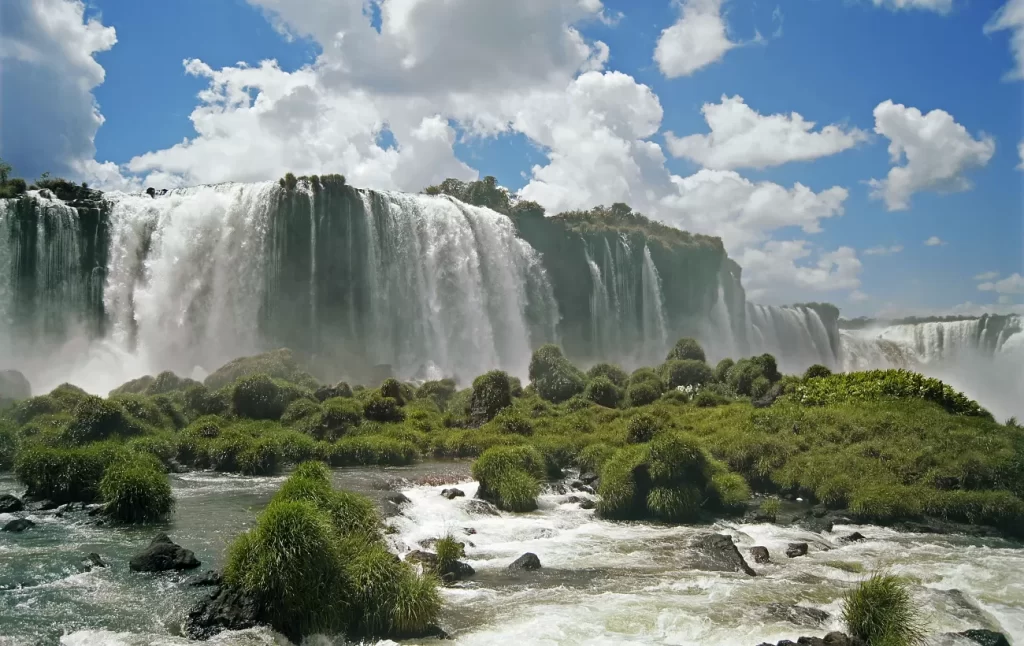
Iguazu Falls, Brazil — the Cataratas do Iguaçu — ranks among the most spectacular natural wonders on earth, and standing before them makes every description feel inadequate. Straddling the border between Brazil and Argentina, the falls comprise 275 individual cascades stretching across nearly three kilometres, carrying the Iguazu River over a drop of 60 to 82 metres at a flow rate that dwarfs Niagara. They are, quite simply, the largest waterfall system in the world.
For the traveller accustomed to luxury, Iguazu Falls Brazil rewards those who go beyond the standard viewing platforms. Private access, expert guides, and the right timing transform a famous landmark into something entirely personal — one of the most memorable experiences in all of Brazil on Foot’s Foz do Iguaçu journeys.
Iguazu Falls Brazil: The Essential Facts
The falls sit within two national parks — the Iguaçu National Park on the Brazilian side and the Iguazú National Park on the Argentine side — both listed as UNESCO World Heritage Sites. The two sides offer entirely different perspectives: Brazil gives the sweeping panoramic view across the full arc of the falls; Argentina puts you inside them, on walkways that stretch to the thundering edge of the Devil’s Throat.
The surrounding Atlantic Forest is home to over 2,000 species of plants, 400 species of birds, and the full range of South American wildlife — jaguars, tapirs, coatis, and giant otters among them. The falls and their ecosystem are managed and protected by ICMBio, Brazil’s biodiversity conservation institute.
The Brazilian Side vs the Argentine Side
Most visitors spend at least one full day on each side — and for good reason. The experiences are complementary rather than repetitive.
The Brazilian side
The Brazilian viewing trail runs along the base of the falls, offering the iconic panoramic perspective that appears on every photograph of the Cataratas. The walkway extends to a point directly beneath the cascade, where the mist is so dense it soaks you in seconds and the roar becomes physical. It is the view most people picture when they imagine Iguazu Falls — and in person it exceeds every expectation.
The Argentine side
The Argentine park covers roughly 80 percent of the falls and offers a network of elevated walkways, lower circuits, and the Devil’s Throat (Garganta del Diablo) — a U-shaped chasm where fourteen of the largest falls converge in a single deafening torrent. Here the experience is immersive rather than panoramic: you are inside the spectacle rather than observing it.
Private Experiences Worth Arranging in Advance
The standard visitor trail at Iguazu is excellent — but private arrangements elevate the experience considerably. These are the moments that set a curated journey apart.
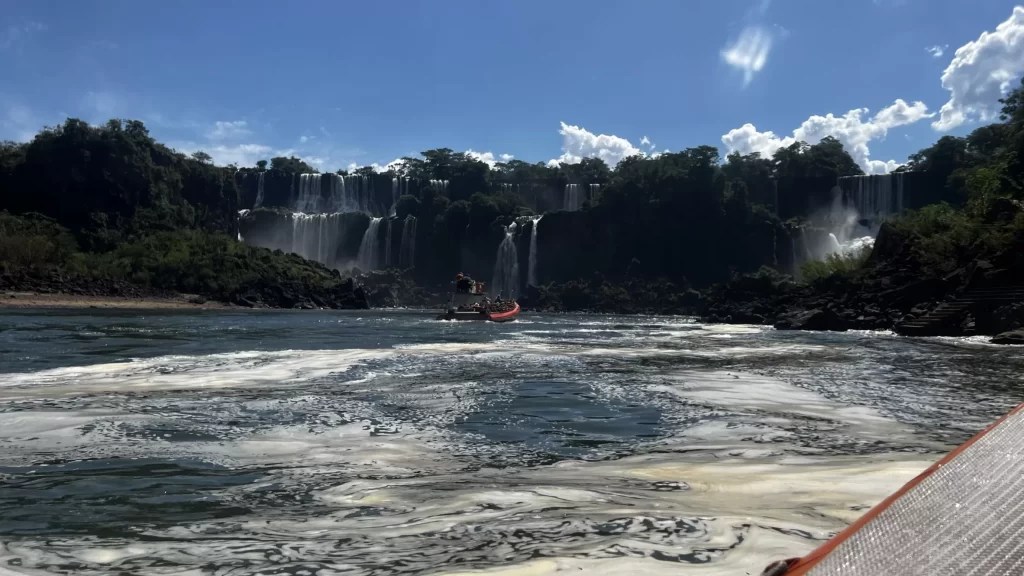
Private boat tour
Speedboats depart from the Argentine side and drive directly into the base of the falls, drenching passengers in the cascade. Arranged privately, with a dedicated guide and flexible timing, this becomes one of the most viscerally thrilling experiences in South America.
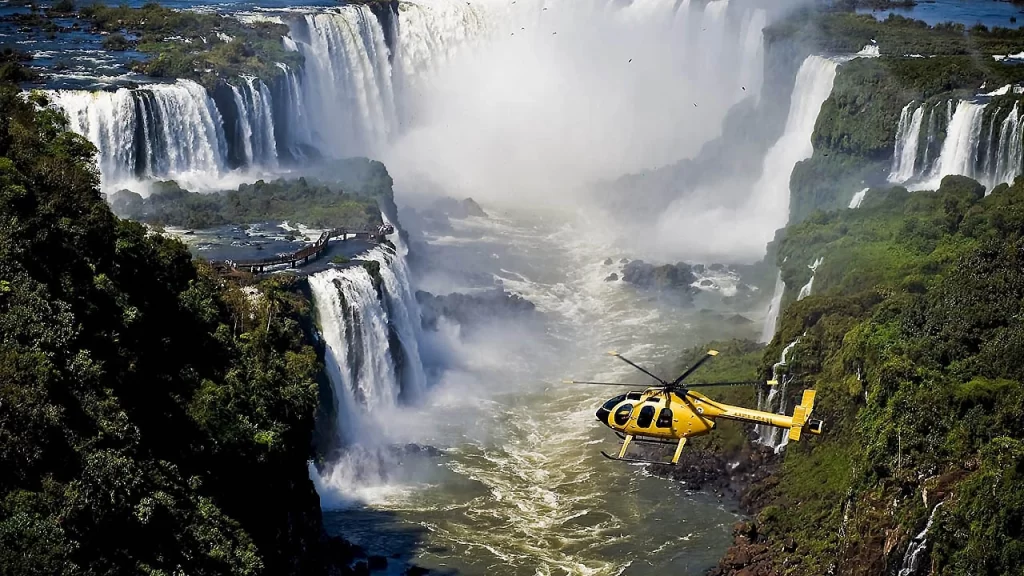
Helicopter flight over the Brazilian side
A private helicopter transfer offers an aerial perspective that no ground-level viewpoint can match — the full arc of the falls laid out below, the forest stretching to every horizon. Operators are regulated by ANAC and flights depart from the Brazilian side.
Private naturalist guide
The forest surrounding the falls is as remarkable as the falls themselves. A private naturalist guide transforms the approach trail into an ecological revelation — spotting birds, explaining the legend of Naipí, and reading the forest in ways a standard tour never reaches.
The Legend of Naipí and the Origin of the Falls
Long before the Spanish conquistador Álvar Núñez Cabeza de Vaca became the first European to record the falls in 1541, the Guaraní people had their own account of their creation. According to legend, a deity planned to marry a beautiful woman named Naipí, who fled with her mortal lover Tarobá by canoe. In fury, the deity sliced the river open, creating the cascade and condemning the lovers to an eternal fall. The coati — the raccoon-like animal that roams the trails today — is said to carry her spirit.
The legend adds a human dimension to a landscape that can otherwise feel almost too vast to take in — and a good guide brings it to life at exactly the right moment on the trail.
When to Visit Iguazu Falls Brazil
The falls are a year-round destination, but the experience changes significantly with the season.
- December to February (summer / rainy season): the highest water volumes produce the most dramatic falls — some of the most spectacular photographs are taken now. Heat is intense and crowds are at their peak.
- March to May (autumn): water levels remain high, temperatures ease, and visitor numbers drop. An excellent balance for those who want full cascades without the summer rush.
- June to August (dry season): lower water levels reveal more of the rock formations and make the forest trails drier and easier. Wildlife is more visible — this is the best window for birdwatching and fauna spotting in the surrounding park.
- September to November (spring): water begins to rise again, the forest is in bloom, and temperatures are pleasant. Often the most photogenic season for the Brazilian panoramic view.
For current conditions and planning, the Iguaçu National Park site is the authoritative reference. We time every Iguazu visit around the specific experiences our clients prioritise — a tailored recommendation, not a generic calendar.
Combining Iguazu with the Rest of Brazil
Iguazu Falls sits at the western tip of Paraná state, geographically distant from Rio, the Amazon, and the Pantanal — but logistically seamless by private charter. Many of our clients combine Iguazu with Rio de Janeiro and one natural destination (Amazon or Pantanal) in a single ten-to-fourteen-day journey, using private flights to connect the dots without long overland transfers.
The contrast between Iguazu’s raw power and the Amazon’s quiet immersion, or the Pantanal’s open wildlife, makes each destination feel more vivid. It is the kind of journey that gives you the full range of what Wild Explorations in Brazil can be.
Design your private Iguazu Falls journey →
Frequently Asked Questions
Where exactly are Iguazu Falls in Brazil?
Iguazu Falls sits on the border between the Brazilian state of Paraná and the Argentine province of Misiones, near the city of Foz do Iguaçu. The Brazilian national park and its viewing trail are on the eastern (Brazilian) side of the Iguazu River.
Which side of Iguazu Falls is better — Brazil or Argentina?
Both sides offer distinct and complementary experiences. Brazil gives the sweeping panoramic view across the full arc of the falls. Argentina puts you on elevated walkways inside the cascade, including the Devil’s Throat. Most visitors who have the time choose to experience both over two days.
When is the best time to visit Iguazu Falls Brazil?
The falls are rewarding year-round. The rainy season (December–March) produces the most spectacular water volumes; the dry season (June–August) offers better wildlife viewing and easier trails. Autumn (March–May) is often the best balance of full cascades, pleasant temperatures, and smaller crowds.
Can you visit Iguazu Falls privately without joining a group tour?
Yes. Private arrangements — dedicated guides, private boat tours, helicopter flights, and flexible timing on both sides — are entirely possible and dramatically improve the experience. Brazil on Foot designs all Iguazu visits as fully private, tailor-made journeys.